Mobility in the Friendly Skies
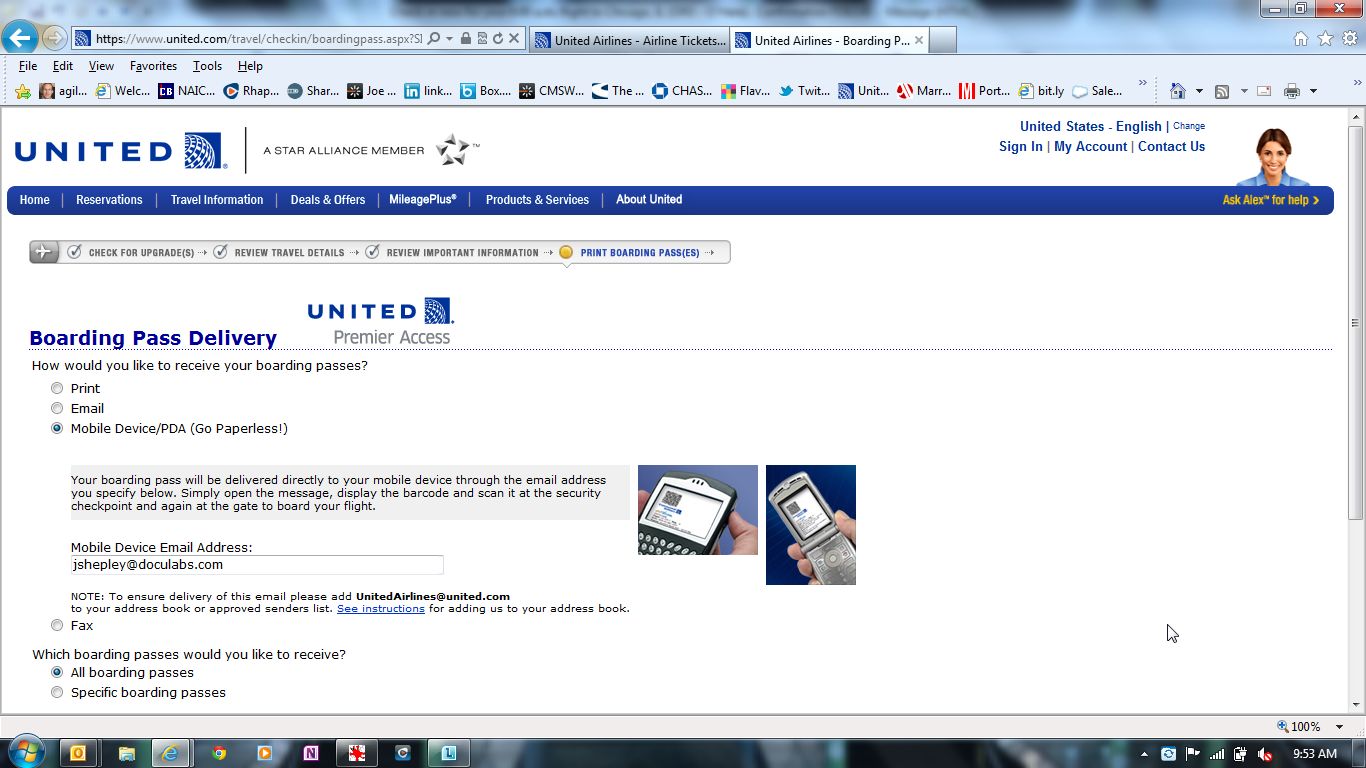
I’ll have to break out my Blackberry 7210 and try out this whole eBoarding thing.
Good news is that if I encounter any problems, I can just page “Alex” (see top right corner), and she’ll call me back at the nearest pay phone with assistance…
Records management…winning!
Last post I was the records management bad cop, calling out the fact that RM at most organizations is failing, i.e., we’re not able to retain and dispose (especially dispose) of records according to the retention schedule across paper and electronically stored information (ESI) in all our repositories (especially shared drives, hard drives, and personal shares).

And while I enjoy dishing out fire and brimstone from my virtual bully pulpit as much as the next pundit, I’d rather be providing some constructive advice on how to avoid hellfire and, if not to reach the promised land, at least to make it to RM purgatory.
With that in mind, I wanted to walk through a framework that does double duty: on the one hand it allows organizations to gauge their RM maturity, and on the other it helps them structure the work they need to do to raise their overall RM maturity level.
Realistic retention poll
Realistic retention, i.e., simplifying your records management (RM) approach to make it actionable while also fulfilling the spirit of the law, is something that a lot of folks out there (both practitioners and clients) are thinking and talking about these days. So I figured I’d put a poll out there to see what you all think…
You can imagine my surprise
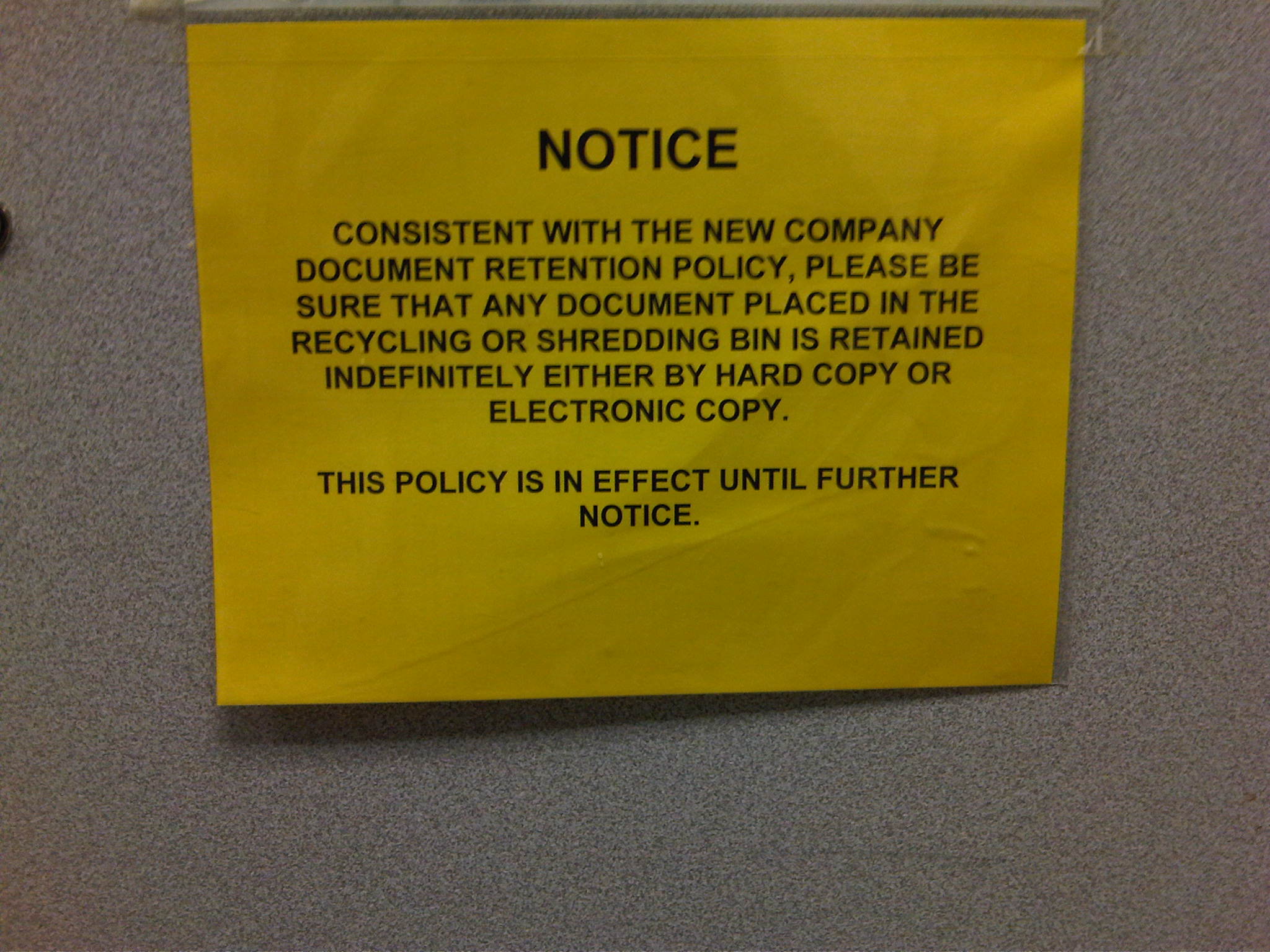
When I encountered this sign at a client while we were on our way to kick off a records management/enterprise content management strategy project!
You are a records management failure
A provocative title, I know, but I think we need a little provocation in the records management (RM) world today. For way too long, we’ve been focused on the wrong things, for the wrong reasons, and the disastrous information management situation in play at 99% of the organizations I encounter is a direct result: we keep everything forever, have adopted corporate policies we can’t follow, either because they are operationally impossible or technically unfeasible (or both), and we derive precious little of the value our information could be providing us if we could only find it and use it effectively.
Give ’em enough rope
Hard to believe making it easier for employees to hoard email would be a selling point in this day and age, but…

The punchline is that it’ll cost on average something like $87,500 to sift through each of these 25 TB when you get sued.
Baby steps: document capture done right (part 3)
Right now, I’m in the middle of a series of posts on how to get document capture right if you’re one of the many organizations struggling with it.
To do that, in the first post, I shared a diagram that maps out a four step maturity model, from paper based, manual processing, to born digital, fully automated processing. And although it’s not rocket science by any means, I probably pull it out of my tool belt once a week and scrawl it on the whiteboard to help organizations understand the path they need to take to improve their document capture capabilities. I’ve found it to be a simple, powerful way to structure organizational thinking about how to address the opportunities for using document capture to improve front- and back-office operations.
Mobility – thinking out loud
I’m speaking on mobility next week at the Info360 conference, and I figured I’d think out loud a bit here both to get inspired as well as to give folks a chance to let me know what’s on their minds so I can try to speak to it in my session.
With that in mind, here’s some of my emerging directions for the presentation next Wednesday.
Baby steps: getting document capture right (part 2)
Last post, I kicked off a series on how to get document capture right if you’re one of the many organizations struggling with it right now.
To do that, I shared a diagram that maps out a four step maturity model, from paper based, manual processing, to born digital, fully automated processing. And although it’s not rocket science by any means, I probably pull it out of my tool belt once a week and scrawl it on the whiteboard to help organizations understand the path they need to take to improve their document capture capabilities. I’ve found it to be a simple, powerful way to structure organizational thinking about how to address the opportunities for using document capture to improve front- and back-office operations.

Figure 1 – Process Management Maturity Model
In this post and the next, I want to walk through some ways that I’ve seen organizations use it to contribute to their efforts to get document capture right:
- Triage
- Roadmap development
- Business case development
- Marketing and communications
Baby steps: getting document capture right (part 1)
Although document capture is about as mature as it gets as far as enterprise content management (ECM) domains go, you wouldn’t necessarily know from the number of organizations I see out there struggling with it.
So I figured it was high time I penned a series of posts on how to get document capture right if you’re one of the many organizations struggling with it right now.


 agile ramblings