SharePoint will own ECM – revisited
Almost three years ago, I did some prognostication about SharePoint owning enterprise content management (ECM) in the not-too-distant future.
At the time, SharePoint 2010 was just released to market and the post raised some eyebrows because I thought it entirely plausible that one day SharePoint could be all the ECM anyone needed (other than heavy-duty workflow and image management).
Before you rush to judge me one way or the other, you need both to understand that I was fresh of the heels of a pretty amazing demo at a F500 client who had made the decision to use SharePoint 2010 as their sole ECM platform and to remember that in the summer of 2010, traditional ECM vendors were scrambling pretty hard to figure out how to position themselves relative to SharePoint.
Three years later, what do I think of my prediction?
You can’t do records management in SharePoint (part 2) — but you’re probably not doing it anyway
In the last post, I called it like I seen it: SharePoint out of the box can’t do records management. 2007, 2010, 2013—none of ‘em left to their own devices are worth much when it comes to automating the retention and (more importantly) disposition of your records according to the retention schedule.
But as if that weren’t provocative enough, I also argued that, regardless of system (SharePoint, IBM FileNet/P8/CMOD, EMC Documentum, OpenText, Hyland OnBase, whatever), and regardless of the capabilities of that system, pretty much no one is actually doing real records management on their electronic content.
Check out the last post to see my reasoning for this being true (and let me know what you think of it). In this post, however, let’s turn to what might be driving the fact that almost no one is doing electronic records management (whether in SharePoint or any other enterprise content management system).
I don’t know what it is, but I’ve been feeling especially cantankerous these days when I sit down to write. It all started with my “SharePoint can’t do records management” series, and I hoped I would cheer up once that was done, but I haven’t.
So, with my heightened cantankerousness in mind, I want to explore something that’s been on my mind for a while now and also see what folks think about it (because you all know how much I love a good heckle-fest).
Basically, I feel like the few viable enterprise content management (ECM) platforms out there (IBM P8/FileNet, EMC Documentum, and OpenText EIM) are, for all intents and purposes, interchangeable, i.e., you could throw a dart to choose one and be as successful as if you did a full, due diligence RFP.
You can’t do records management in SharePoint
Let’s start this admittedly provocative post with a question: Anybody out there actually doing records management in SharePoint?
And before you answer, let me emphasize that I mean real records management, like, with actual, system-enabled automated disposition according to your retention schedule.
If you answered “yes” to this question, please jump immediately to the comments section and let us all know (and while you’re at it, give us some indication of how on earth you’re doing it), because based on my experience, I’d be willing to bet the answer to this question is going to be “no” in 99.9% of all cases.
And while I’m in a betting mood, I’d also be willing to bet that if you answered “yes”, you 100% aren’t doing it with out of the box SharePoint, because out of the box SharePoint can’t do records management at the level the vast majority of organizations require—it just doesn’t, people, no matter how much Microsoft claims that it does, or trumpets that fact that they themselves use it to. But don’t just take my word for it, ask Bruce Miller.
Transformational ECM VI: Oil and Gas (part 3)
I’m at the end of a series of posts looking at how enterprise content management (ECM) can transform oil and gas (O&G) organizations. In the last post, I walked through some of the strategic transformations ECM can contribute to if it’s aligned properly. In this post, I want to wrap things up by looking at more tactical transformations that ECM can align with to drive tangible business benefits.
Without rehashing the last post, let’s review the main areas of strategic alignment that ECM impacts at O&G organizations before digging into the tactical:
- Mergers and acquisitions – scope and price more accurately, integrate more effectively, realize value more quickly
- New ventures – scale to support the breakneck growth of current O&G environment
- One culture – move from being merely multi-national to truly global
- Goal zero – produce hydrocarbons at the highest level of safety at maximum efficiency
Transformational ECM VI: Oil and Gas (part 2)
In the last post, I began to talk about how enterprise content management (ECM) can transform Oil and Gas (O&G) organizations in some fundamental ways. By way of a prelude, we spent most of the time talking about how not to sell the benefits of ECM to business stakeholders. In this post, with the prelude out of the way, let’s turn that frown upside down and talk about how you in fact should sell the benefits.
Without recapping the entire last post, suffice it to say that O&G companies care about one thing: producing hydrocarbons safely and efficiently. So business stakeholders need to understand how exactly ECM–or anything else, for that matter–contributes to that effort. Otherwise, no amount of best practices, industry standards, or smart-guy consulting frameworks are going to get them to support ECM at their organization.
Transformational ECM VI: Oil and Gas (part 1)
A while back, I did a series of posts on transformational ECM that looked at the value ECM could provide in industry-specific terms, from insurance and financial services, to mining, for-profit education, health payers, and consumer packaged goods. In the time since, I’ve had the good fortune to do a slew of projects in some other industries and want to share some of my insights on how ECM impacts them.
First and foremost have been some great Oil and Gas (O&G) projects, both for global, integrated organizations as well as folks who specialize in upstream and midstream operations–all of which have offered wonderful insights into how O&G organizations can benefit from ECM in very business-specific (read, non-IT) ways.
But before we dig into the ways ECM can transform O&G organizations, let’s spend a little time talking about how not to frame up ECM benefits for O&G folks.
A Word About Selling ECM Benefits to an O&G Organization
Anyone who’s worked in any capacity with O&G companies will tell you that if it ain’t about producing hydrocarbons safely and efficiently, your mouth is moving, but all I hear is “blah blah blah blah”. So if you’re looking to sell an O&G business person on the merits of ECM, you better be able to articulate clearly how managing documents and content better will directly impact their bottom line, i.e., producing hydrocarbons safely and efficiently.
We’ll get to what this looks like in a minute, but what this definitely does not look like is the following:
Your employees spend lots of time searching for documents they need but can’t find, and aren’t even sure whether the documents they can find are the right versions. Doing better ECM will make it easier to find and share documents, which will save your employees tens of hours a week each on average, which will lead to millions of dollars a year in savings.
First of all, forget O&G, your explanation of ECM benefits to the business in any industry should never look like this, not because it’s not true–of course it is–but because it tells the truth about bad document management practices from a very shallow (and very lazy) perspective.
Here’s what I mean: it’s a bit like telling a grossly overweight person who smokes that they’ll “get sick” if they don’t change their ways. Yes, they’ll get sick, but as a doctor who has hands-on experience with exactly what happens to folks in this situation, you are privy to details that would paint a more graphic picture and potentially more effectively help get this person to change their ways.
It’s the same for ECM. General, net to productivity benefits are indeed important and will follow from improving document management practices. But there are a whole host of other benefits that are far more tangible and far more meaningful to business folks. Focusing on those will get ECM further at the organization and increase the likelihood of realizing the net to productivity benefits as well.
The Final Word
Okay, so much for my soap box digression on how to talk about the benefits of ECM. In the next post, we’ll dig into how ECM specifically can help O&G organizations–hopefully avoiding any net gains to productivity type generalizations and honing in on tangible business value. In the meantime, I’d love to hear from folks out there about their own experiences with articulating the value of ECM, whether for O&G or other industries…jump in, and let’s get the conversation started!
It’s an honor
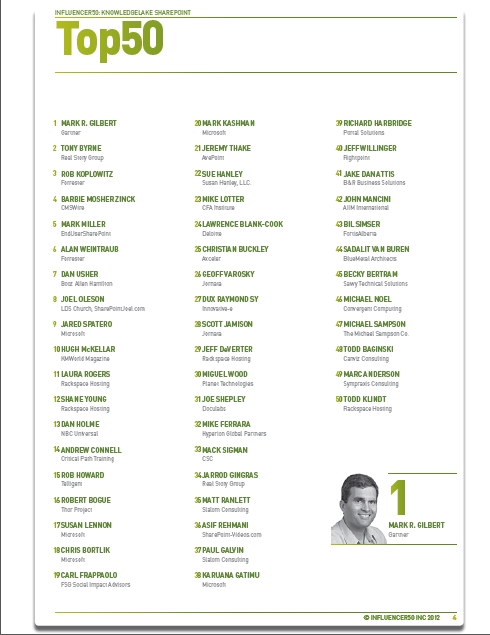
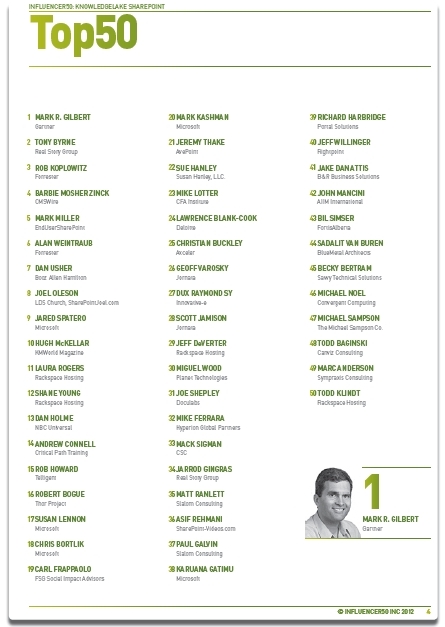
I found out over the weekend that I was named one of the Top 50 SharePoint influencers for 2012. It’s a great list of folks, and I’m honored to be included with all of them.
I told you so
Just got a note that Clayton Christensen is speaking at BoxWorks this year.
 Now, I’m a huge Christensen fan, so I’m excited to get the chance to see him in person.
But I’m also excited because a while back, I wrote a post on SharePoint’s radical disruption of ECM using Christensen’s model of disruptive innovation as a heuristic. In that post, I examined the growth of SharePoint along the basic contours of how Christensen views all radical, disruptive innovations, closing with the thought that, if Christensen is right, ECM will become a commoditized, run of the mill capability, able to be practiced by the majority of non-specialist users out there.

So seeing him at BoxWorks, a conference run by a software company whose product disrupts SharePoint in the very same way SharePoint once disrupted big ECM, is a good I-told-you-so moment. Which makes up for all the regrettable “Future of ECM” posts I’ve written that turned out to be as inaccurate as 1950s visions of the home of the future that, as regrettably, never became reality.
McKinsey: the value of social collaboration technologies
As usual, great stuff from McKinsey–worth digging into.
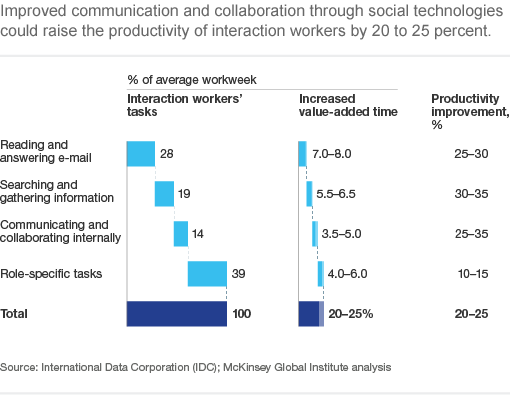
Now if only more CXOs would actually write the check to do enterprise collaboration right, we’d have something here.
But almost no org I’ve come across has been willing to do what it takes to realize these productivity gains because they’re “soft”…unless you can somehow figure out what your employees will be doing with all that free time and tie it to business results.
How about you folks out there? You think these numbers would spur CXOs to action, or just generate more lip service?


 agile ramblings