Watson Leaves Deal or No Deal with $9,000
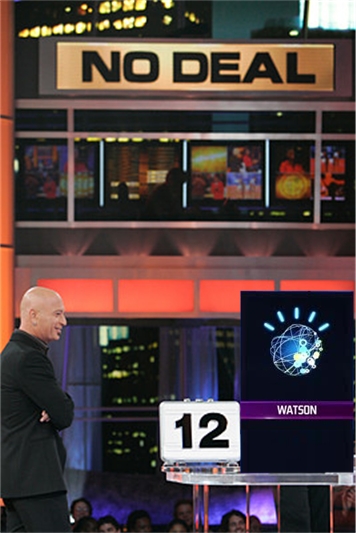 Burbank, CA—In a highly anticipated follow-up to his appearance on Jeopardy, Watson, IBM’s latest supercomputer, went head-to-head with the enigmatic Banker from NBC’s Deal or No Deal Thursday. In contrast with his dominance over his opponents on Jeopardy, however, Watson left DOND with a disappointing $9,000.
“He was a great competitor,” DOND host Howie Mandel said of Watson, “and played a very gutsy game.”
After a strong start where he managed to keep the entire left side of the board in play, Watson began to falter.
Watson turned down a substantial offer of $367,000 from the Banker, eliciting gasps side by side with hooting and fist-pumps from the studio audience. “I didn’t come all the way down here to walk away with small money,” Watson told Mandel, “no deal!”
Watson then proceeded to open the $75,000, $500,000, and $200,000 cases, prompting one of his supporters, IBM’s Deep Blue, to observe that Watson, “still had the $1,000,000 case up there—no deal! No deal!” which elicited raucous cheers—along with some befuddled head shakes—from the studio audience.
Deep Blue’s sentiments were echoed by a rack of Blade servers hosting IBM’s SPSS predictive analytics software platform: “You’ve been through so much to get here, you deserve this—that Banker’s got nothing on you!”
Watson, visibly buoyed by his supporter’s words and the cheers of the crowd, rejected the Banker’s eventual offer of $175,000, subsequently opening the $1,000,000 and $750,000 cases to the stunned groans of the studio audience. The Banker then offered him $95,000 in response. But before his supporters or Mandel could even say a word, Watson responded, “I’ve come too far to stop now. No deal!”
As the cheers of the crowd died down, Watson opened the $100,000 case, prompting the Banker’s offer of $9,000. After a few moments of silent consideration, Watson accepted the offer to the subdued clapping and shoulder shrugging of the studio audience.
As Watson’s supporters and friends crowded around, Mandel opened Watson’s case, revealing $50,000 inside.
“It looks like you made a bad deal, Watson. But I want to thank you for playing such a great game—you were a real competitor,” Mandel observed.
IBM has yet to release an official statement on Watson’s DOND performance, but so far the technology giant has not cancelled Watson’s scheduled appearances on Card Sharks and Tattletales next month.
Transformational ECM III: Consumer Packaged Goods
I’m in the middle of a series on organizational transformation that focuses on how enterprise content management (ECM) should be seen less in terms of technology, process, compliance, or risk management, and instead as a powerful force for transformational change at organizations.
In recent posts, I’ve taken a close look at how ECM is transforming health payers and mining companies. But in this post, I want to turn to an industry that has traditionally been lukewarm on ECM: consumer packaged goods (CPG).
Transformational ECM II: Mining
I’m in the middle of a series on organizational transformation that focuses on how enterprise content management (ECM) should be seen less in terms of technology, process, compliance, or risk management, and instead as a powerful force for transformational change at organizations.
In the last post, I took a close look at how ECM is transforming health payers, particularly in terms of their ability to respond to emerging health care reform legislation.
In this post, I want to get my hands dirty a bit to look at a vertical that’s been experiencing tremendous growth in the last 18 months and is poised for even more growth in 2011: mining. I’ve worked closely during this period with some global mining companies and had the opportunity to witness firsthand the potential ECM holds for transformation in the mining industry.
Transformational ECM I: Health Payers
In the last post, I kicked off a series on organizational transformation by getting on my soap box about how ECM should be seen less in terms of technology, process, compliance, or risk management, and instead as a powerful force for transformational change at organizations.
With that done, I want to turn to the first post in the series and take a look at an industry vertical that’s been getting a lot of attention lately—health payers.
With the advent of health care reform, payers across the board (from smaller, single-state Blues to for-profit national giants) are under tremendous pressure to reimagine their operating models to keep pace with the dynamic, emerging shape of health care legislation coming out of Washington.
I’ve been doing a lot of work recently with health payers, and over the last 18 months in particular, I’ve seen ECM come into its own as an important tool available to payers to overcome the challenges they face between now and 2014.
Likely effects of health care reform
If you ask folks involved in health care what they think of health care reform (HCR), you’ll get a lot of different answers. But one thing everyone would agree on is that no one has any idea what the final shape of HCR will look like—the legislation, despite being thousands of pages long, moves in generalities that require further elaboration to be implemented.
That having been said, I think we can take an educated guess at some big bucket effects likely to come about due to the current trajectory of HCR.
- Communications required with members and providers will rise, both in terms of kind and frequency
- Intensifying scrutiny of payer/provider activities, leading to increased federal litigation
- There’s been recent high-profile litigation activities in MI, PA, MA, and the DOJ has specifically mentioned the payer/provider relationship as an area of interest going forward
- The current administration has singled out Blues as “anti-competitive” on numerous occasions
- Heightened pressure to modernize systems and applications
- There’s already been a spate of regulation impacting payer technology (e.g., ICD 10, Mental Health Parity)
- The current administration places high value on the use of technology to improve how they do business (e.g., appointing a Federal Government CIO, using crowdsourcing to surface and rank problems for the administration to tackle, etc.)
All three of these likely effects not only have big price tags associated with them, but could well be impossible for some smaller payers to react to while remaining financially viable.
Broad ECM solution areas
And while there different ways a payer might choose to address these challenges, ECM supports some critical solution areas that can contribute signally to overcoming them.
- Customer Communication Management (CCM) – by improving the way payers create and deliver communications to members and providers
- Automation of the authoring process
- Multi-channel delivery of content (“write once, publish many”)
- Print suppression
- Records Management – by addressing over-retention to reduce the amount of likely discoverable content
- Less content needs to be put through the discovery pipeline in the first place
- Faster and easier to pull back initial data set required by a litigation event
- Fewer “smoking guns” lurking out there
- Storage Management – by reducing the volume of content stored on systems and applications to enable more agile IT delivery
- Less budget spent on storing content that has passed it’s legal and operational usefulness – can be applied to new development that increases organizational capacity to respond to HCR
- Easier to implement, update, or sunset systems and applications
Real world examples
And this isn’t all theory: I’ve personally been involved with payers over the last year and a half who have addressed these three ECM solution areas with real-world initiatives:
- Enabling web self-service and mobile delivery, suppressing paper communications
- Moving off of shared drives and onto document management systems
- Deploying reusable SharePoint templates (with compliance requirements baked in) to meet common business needs across the organization
- Reducing the number of letter templates in use, streamlining/automating the correspondence authoring process
- Centralizing the management of off-site paper storage to reduce the amount of documents sent to storage facilities to cut monthly storage costs and reduce the legal risk associated with maintaining warehouses full of likely discoverable paper records that are past their retention periods
Have the payers adopting these initiatives solved the challenges of HCR once and for all? Of course not. But they have realized important incremental gains as a result: cost savings to contribute to administrative cost reduction commitments, net gains to productivity that can be applied to higher-value activities directly related to responding to HCR mandates, and improved system performance that delivers increased technology capabilities without new investments.
They’ve also significantly improved their litigation risk profile by addressing over-retention: they’ve reduced the amount of content they keep that has passed its legal and operational relevance, which lowers discovery cost and risk in addition to making day-to-day operations less costly (IT storage, line worker efficiency, system performance).
The final word
So there you have it–a snapshot into how payers are using ECM to respond to the demands of HCR. In the next post, we’ll turn to another industry vertical that’s an exciting, if unexpected, ECM practice area: mining. With the recent run up in commodity prices, mining companies have been not only generating tremendous profits, but investing those profits in improving their operations. And like health payers, ECM is an important part of these improvements.
But in the meantime, jump in and share your experiences and thoughts on health payers and ECM–I’d love to hear from folks out there!
Transformational ECM
You hear a lot of talk about ECM from technology, vendor, process improvement, compliance, and risk angles: what technology does what, which vendor will buy or get bought, how it can help you fix broken processes, improve compliance, minimize risk, and so on.
But the more I work with organizations on developing ECM as a strategic capability, what strikes me is that, at its heart, ECM is mostly about transformation: transforming content as it moves through its lifecycle; transforming processes as they get measured, managed, and optimized; transforming technology as it evolves from a disparate collection of localized, siloed solutions to an enterprise shared services platform; and finally transforming organizations as they make content transparent, portable, and reusable in order to reduce risk, lower costs, or increase margins (or all three).
Use what you got
I came across a wonderful quote in Redefining Health Care by Porter and Teisberg the other day:
Despite the unmistakable opportunity to improve quality and lower costs simultaneously, a surprising number of system participants still assume, and act, as if advancing the state of the art in health care required more services and more expensive technology. This can sometimes be true, especially in the early life of a new technology, but the far greater opportunity today is to use better the technologies known already. (p. 111)
Swap out “health care” for “ECM” and this quote is spot on for the work I do day-to-day with clients and in the industry.
The year in review
I thought I’d step back from ECM for a moment, get a little self-indulgent, and look back over the first year of agile ramblings to see how things went–and also look forward a bit to some of my goals for 2011.
First, some stats for the year:
- Launched 1/28/2010
- 77 posts – 7 posts per month
- 4,767 total visits – 433 visitors per month
- 117 visits – highest volume day
- 93 comments – 1 comment per post
Nobody wants a drill, they want a hole in the wall
With this post, we come to the end of the series that’s been focusing in on my approach to taxonomy, which I introduced in the initial post (Irrelevant Taxonomies). My goal throughout has been to contrast my approach with how I see taxonomy typically done, as well as to solicit feedback, comments, and general heckling from you all out there–nothing like industry scorn to sharpen your ideas, right?
In that initial post, I introduced a number of dichotomies about relevant versus irrelevant taxonomies; in this series of posts, I’m taking the time to explain more about each of these dichotomies.
That having been said, let’s dive right in to the final dichotomy: are seen as ends in themselves or as a means to an end that is of questionable value to the organization versus are seen as a means to an end that is important to the organization.
That and a quarter’ll get you on the bus
Right now I’m in the middle of a series that focuses in on my approach to taxonomy, which I introduced in a previous post (Irrelevant Taxonomies), both to contrast it with how I see taxonomy typically done as well as to solicit feedback, comments, and general heckling from you all out there–nothing like industry scorn to sharpen your ideas, right?
In that initial post, I introduced a number of dichotomies about relevant versus irrelevant taxonomies; in this series of posts, I’m taking the time to explain more about each of these dichotomies.
That having been said, let’s dive right in to the fourth dichotomy: Have no tangible, business relevant metric to impact versus have at least one tangible, business relevant metric to impact.
Take sides
Over the next few weeks, I’ll be spending a few cycles digging in to my approach to taxonomy, which I introduced in a previous post (Irrelevant Taxonomies), both to contrast it with how I see taxonomy typically done as well as to solicit feedback, comments, and general heckling from you all out there–nothing like industry scorn to sharpen your ideas, right?
In that initial post, I introduced a number of dichotomies about relevant versus irrelevant taxonomies; in this series of posts, I’m taking the time to explain more about each of these dichotomies.
That having been said, let’s dive right in to the third dichotomy: being application neutral versus being application specific.


 agile ramblings