DIA EDM and EDS – Day One Recap
I just got done with day one of the DIA EDM and EDS conference in DC. It was a great day, with lots of strong sessions, compelling speakers, and a rich cross-section of vendors and service providers in the expo. Based on the sessions I saw and conversations I had on the networking breaks, I wanted to share some initial observations about the state of life sciences document management.
Silos
It’s safe to say that at most large life sciences organizations, information and documents are almost completely siloed by function. Even if there’s a common platform enterprise wide, documents across the product lifecycle are stored in isolated buckets that are difficult (if not impossible) to access across those functions. R&D, clinical ops, reg ops, reg affairs, med affairs, manufacturing, quality, PV–they all have a shared interest in a given product going to market successfully, yet their documents (and the underlying business processes) live in isolation from each other, with all the negative effects one would expect, e.g., findability, rework, orphaned information, process inefficiencies (esp. longer time to market), compliance risk, etc.
Affiliates are the Future
For most large life sciences organizations, global affiliates are an important growth area…if not THE most important growth area for the bottom line. Emerging economies in BRIC as well as other developing nations represent huge growth opportunities for global life sciences organizations over the next decade. However, their ability to realize these potential opportunities relies heavily on the effectiveness and efficiency of their affiliate regulatory operations. Yet from everything I’ve seen so far at the show (and that I’ve been hearing from folks in the industry over the last few years), most organizations struggle to empower their global affiliates to develop effective submission capabilities. In fact, one document management vendor I spoke with at the show thought that most organizations could shave four to five weeks off the time to approval in their global affiliates–four to five weeks, people…at how many hundreds of thousands to millions of dollars per day? Yet very few organizations are addressing their affiliate challenges head on. Not sure why.
Product Lifecycle Management
Without a doubt, almost universally, I heard folks complain that life sciences organizations are approaching their documents and information from a functional, rather than a product lifecycle, perspective. That is, they slice and dice their org into R&D, clinical ops, regulatory ops, manufacturing, quality, PV, etc. rather than by product or product line. The result is that organizations struggle to respond to regulatory requests for information within mandated timeframes, to leverage existing IP for new product development and product extension, to drive the predicted value out of mergers and acquisitions, and to improve process efficiency to speed time to market.
The Final Word
So much for day one. Not sure if these issues will be solved days two and three, but I look forward to encountering more data points on each, having impassioned conversations about how to address them, and meeting like minded practitioners who are committed to solving them at their organizations. And if you’re at DIA EDM and EDS, let me know, and we can get together to talk about all this in person…
DIA EDM and ERS Show – Sneak Peek
 With DIA EDM and ERS coming up next week, I wanted to share some of my thoughts on what I’m looking forward to at the show.
Fran Quinn’s session on Internal Collaboration Activities within a Large, Departmentalized and Geographically Distributed Organization should be a good one. I’ve been having lots of conversations with life sciences folks about using social collaboration tools for internal use cases, like collaboration on global regulatory submissions, not just external ones, like study recruitment or PV. Hopefully we’ll get some insight into how Pfizer is tackling this in reg ops and some inspiration for how to start doing it in our own orgs.
Fran’s talk is Monday Sep 22, 1:30PM – 3:00PM, Session 1 Track 2.
Charles Deeck’s Case Study: Transitioning from Enterprise Applications to a Cloud Based Regulatory Information Management System (RIMS) is another talk I’m looking forward to. Moving doc management to the cloud has been something nearly all the life science folks I speak with are considering, if not actively investigating. Although ARIAD’s a smaller organization, based on the slides he uploaded on the conference site, there should be lots of real world insight and advice that even doc management practitioners from large organizations can learn from.
Charles’ talk is Tuesday Sep 23, 8:30AM – 10:00AM, Session 3 Track 2.
Mary Emanoll and Dave Clark are teaming up for a case study, Organizational Transformation through Content Management Optimization–a topic that’s near and dear to my heart (as those of you who know me know well)! This can be a very motherhood and apple pie topic, so glad to see this is a case study that promises to have lots of good take aways for folks to use at their own orgs.
Mary and Dave present Monday Sep 22, 3:30PM – 5:00PM, Session 2 Track 1.
Christian Buckley’s Leveraging the eCTD for Global Efficiency is another topic that’s a big one for me. So many global reg ops organizations struggle to optimize the hand off between US/EU and affiliates–and doing so is a big part of getting time to market down for products in ROW. Although it’s not a case study, hopefully we get some nuggets from Christian’s work with Astellas, AstraZeneca, and SmithKline Beecham.
Christian’s talk is Monday Sep 22, 1:30PM – 3:00PM, Session 1 Track 1.
Too many other good sessions to include them all here, but hopefully these four get you excited for the show! And if you’re going to be in DC, shoot me a note and let’s connect and talk shop…
Information Management and the Pharma Value Chain
 In the lead up to DIA, I put together my thoughts on how the pharma value chain can be transformed by improved information management in a post on the Doculabs site. If you haven’t already checked it out, get over there now and then let me know what you think. Pharma (and life sciences in general) is at a very interesting place on a number of levels, particularly in terms of information management. I’d love to get a good conversation going about all this…so jump in!
Sink and share?
It seems like analyst types and talking heads (that’s me) are always looking for whitespace – after all, one way to add value to a domain is to point out places where either practitioners and organizations aren’t paying enough attention or will soon be paying lots of attention. For me, one of the most glaring swaths of whitespace in enterprise content management (ECM) is the integration between sync and share capabilities and behind the firewall ECM platforms.
Confessions of a Reluctant Salesman
 I came to sales, if not kicking and screaming, then certainly not doing backflips. Until four years ago, I was always a doer: musician, teacher, editor, project manager, business analyst, IT leader, then consultant (yes, folks, consulting does count as doing something). In 2010, however, I got the opportunity to step into a role at Doculabs that was my first serious sales role.
Sure, at the time I told myself it was business development, not sales, as if that would somehow insulate me from the unsavory, somewhat slimy world of selling people things. But in the end, of course, they both really amount to the same thing: you need to convince folks who aren’t doing business with you to do business with you by selling them something. Full stop.
Now, to be fair, I had (and continue to have) other responsibilities at Doculabs: creating and nurturing new service offerings, contributing to our go to market strategies, sponsoring and delivering on consulting engagements, coaching and mentoring my colleagues, growing the Doculabs brand through thought leadership activities, and working with my fellow leadership team members to chart a course for Doculabs as a whole to ensure that it will continue to thrive for years to come. But the fact is, if we don’t sell our services to clients, then all the rest of this stuff is meaningless—without a viable business, we have to pack it up and go home.
Connect-IT Conference
I’m excited to be co-chairing a new enterprise content management (ECM) conference this spring: Connect-IT. The goal is to bring ECM leaders from IT and the business together to spend two days sharing what works and what doesn’t on customer led panels and sessions and networking with peers across industries.
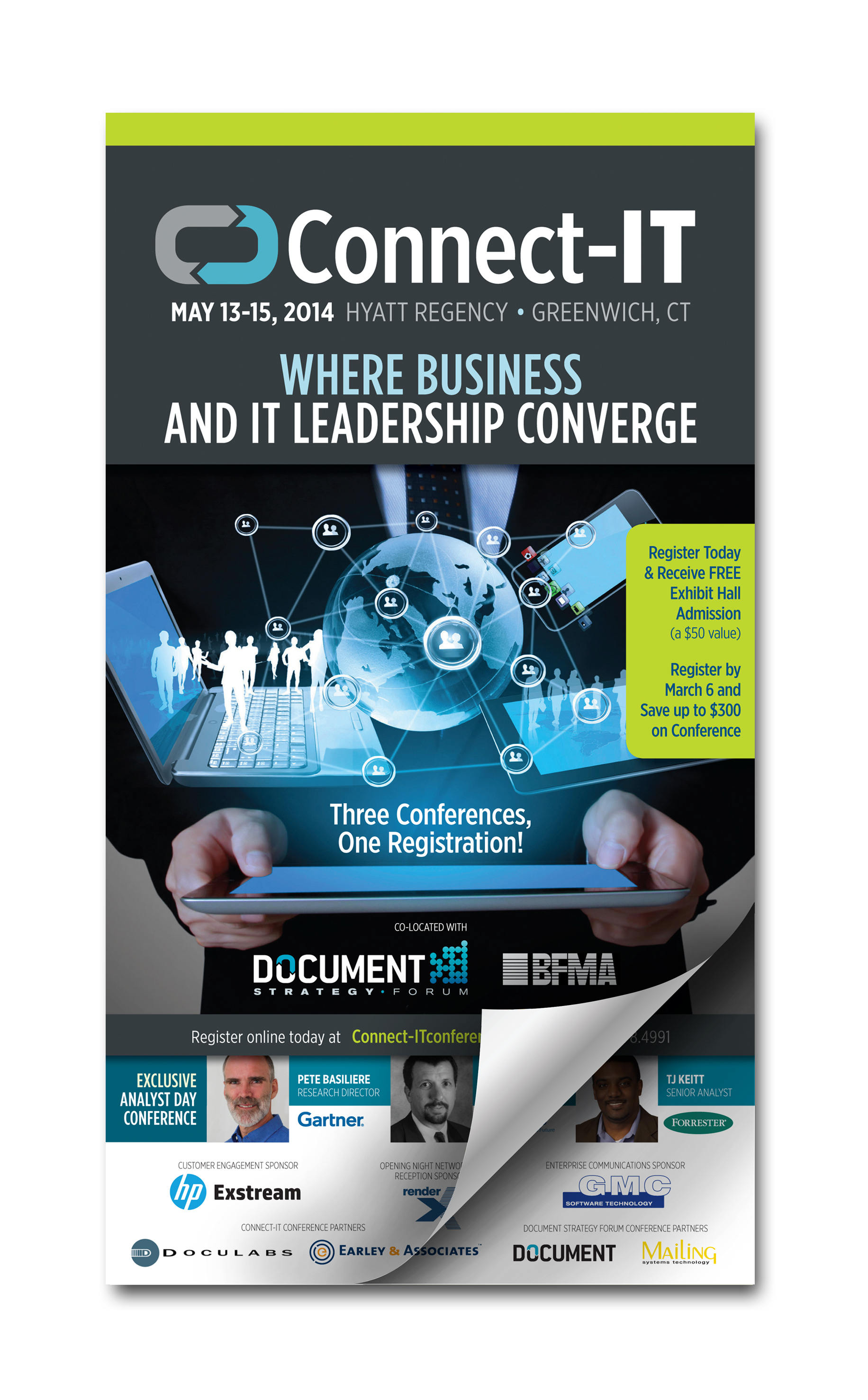
The conference is May 13-14 in Greenwich, CT and is gearing up to be a great two days. Advanced registration is going on now – click here to check out our brochure, which has full information about the conference.
You can also join our LinkedIn group to stay up to date with what’s going on with the conference leading up to May, connect with other attendees, and continue your discussions and networking after the conference is over.
In the coming weeks, I’ll be posting more information here, both about speakers and topics, so I hope even if you aren’t able to make it this year, that you’ll find the information valuable and keep Connect-IT in mind for your 2015 plans.
Mobile content management
 So I did my first Google Hang Out – http://bit.ly/1e52enP. Other than not smiling and looking like a wax mannequin while listening to the other folks talk, I think it went well!
Thanks to David Jenness from IBM for hosting it and to Larry Hawes from Dow Brook Advisory Services for participating with me.
Would love to hear what folks think–so click through, watch it, and come back and heckle!
AIIM Roadshow in Chicago
On Thursday, October 3rd, AIIM is bringing their “Information Governance in a Social & Mobile World Seminar” to the Doubletree by Hilton in Arlington Heights, IL. Doculabs is participating. Stop by our table if you’re there. Doculabs co-founder and information management guru Richard Medina will there and would love to talk about information governance or anything else you have in mind.
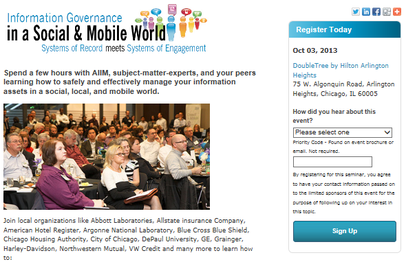 Here’s AIIM’s description of the event:
AIIM President, John Mancini, subject-matter-experts, and your peers will come together to learn how to:
- Automate core records management processes
- Reduce litigation costs, risks, and storage costs by responsibly getting rid of everything that has no business value
- Tap into the advantages of social systems without increasing business risk
There’s no charge to attend the seminar, you don’t need to be a member, and you’ll join local organizations like Abbott Laboratories, Allstate, American Hotel Register, Argonne National Laboratory, Blue Cross Blue Shield, Chicago Housing Authority, City of Chicago, DePaul University, GE, Grainger, Harley-Davidson, Northwestern Mutual, VW Credit and many more.
Check out the program agenda and register (for FREE) here.
No one cares about compliance
At least not enough to pay for it, it seems to me.
Here’s where I’m coming from: I’ve been at Doculabs helping clients for a little over six years now. In that time, I’ve worked with something on the order of 120 Fortune 1000 organizations directly and had substantive discussions with probably four or five hundred others at conferences, through marketing events, and doing general business development. And I can count on one hand (with some fingers left over) the number of organizations I’ve seen fund any kind of enterprise content management (ECM) initiative based on risk or cost avoidance alone.
Look at it this way: every Fortune 500 company has a substantial e-discovery problem, big time compliance constraints, and a serious over-retention problem. And lots of them will tell you that they are “very, very concerned” about these and that they have the support to do something about them (or at least are getting close to getting that support). And, imagine this, they may even have the money to hire a strategy consulting firm to help them build out the business case and roadmap for solving these problems. But no matter how good that strategy and roadmap may turn out to be, when the chips are down and their CXOs have to decide yea or nay, I’ll always put my money on a nay—especially given the current economic climate.
Why’s that?
First, cost and risk avoidance are always less attractive than direct cost savings or revenue generators. And in any given budget cycle, it’s a 100% certainty that your CXOs are reviewing a portfolio of projects that include a good many that drive direct cost savings or revenue generation. Next to them, your ECM initiative to avoid cost and risk will pale in comparison.
Second, consider the organizational change management required. Let’s assume that you make the cut and survive the first round against all those direct cost savings and revenue generating projects. Shortly thereafter, your CXOs will calculate the change management required to achieve the return your project promises. Here’s where things get really bad for ECM, because it order to impact e-discovery, compliance, and over-retention in any meaningful way, ECM requires that pretty much every knowledge worker has to change the way they work every day, day in and day out with every document they touch. That’s a big deal at no matter the organization and will make your CXOs pause, because I can bet you that almost no other proposal they’re considering will have quite so big an organizational change management price tag.
Third, and finally, consider the riskiness of the proposed initiative, i.e., how likely is it to succeed (or fail)? To answer this, your CXOs are going to look into two things:
- How many successful ECM programs have they seen in their travels in the wider world of business? (Answer: not many)
- How often has their organization succeeded in this kind of initiative? (Answer: not often)
On the flip side, they’re going to ask, how would we be better off funding the ECM initiative rather than doing more of what we typically do in our operations, e.g., building another cell tower, bringing another crusher on-line, drilling more wells, hiring more financial advisors, standing up more factories, etc.?
Answer: we wouldn’t be better off, because the huge increase in cost savings, revenue, or margins due to these projects will more than offset any e-discovery, compliance, or storage cost and risk we currently face.
The result? Unless you can argue successfully for a direct line to revenue, savings, or margin, don’t hold your breath to get your ECM initiative funded.
The Final Word
So much for my admittedly biased perspective. Have a different one? Been part of an ECM initiative that was funded based on cost or risk avoidance alone? Think I’m crazy in general? Great! Jump in, and let’s get the conversation started!
James Matthew Shepley
Just wanted to let everyone know I’ll be a little busy with our newest addition, James Matthew, born this morning.
So the blogs may be a bit slow in coming these next few weeks (months?)…I’ll dive back in to SharePoint, records management, and ECM once I come up for air!



 agile ramblings