Painting a bridge
I’m spending a few cycles digging in to my approach to taxonomy, which I introduced in a previous post (Irrelevant Taxonomies), both to contrast it with how I see taxonomy typically done as well as to solicit feedback, comments, and general heckling from you all out there–nothing like industry scorn to sharpen your ideas, right?
In that post, I introduced a number of dichotomies about relevant versus irrelevant taxonomies; in this series of posts, I’m taking the time to explain more about each of these dichotomies.
That having been said, let’s dive right in to the second dichotomy: strive to be comprehensive vs. strive to address only the highest value/impact areas of the organization.
Cereal in the saucepan
As I mentioned in the last post, Irrelevant Taxonomies, I want to spend a few cycles digging in to my approach to taxonomy, both to contrast it with how I see taxonomy typically done as well as to solicit feedback, comments, and general heckling from you all out there–nothing like industry scorn to sharpen your ideas, right?
I thought I’d begin by explaining more about each of the dichotomies I introduced in the last post.
Irrelevant taxonomies
I’ve been working on a number of taxonomy projects lately and each one has reminded me both how relevant and how irrelevant to the business a taxonomy project can be depending on how it’s done.
Now before I get too far ahead of myself, I’ll start by acknowledging that taxonomy projects can have a wide range of goals, from optimizing file plans to branding and corporate strategy. So let me level set here by saying that this post (and any follow ons) will be concerned with a narrow slice of that range: taxonomy projects for document management.
But despite this narrower focus, I hope that the subject will have wide applicability, because document management is one of the most ubiquitous use cases for taxonomy (alongside areas like website design and user experience).
Grassroots COE
I’ve written quite a bit here about centers of excellence (COEs) and how they can contribute to the organization. And while some of my posts focused on the practical, tactical aspects of building COEs, the perspective was overwhelmingly an enterprise one that assumed centralized (or at least formal) support for the COE concept at the organization.
But many COE efforts happen in a less formal arena, without top down (or even mid-level) support. Often the COE starts when an IT application manager gets the OK from their boss to hold stakeholder meetings to talk about improvements to the application, discuss open defects and the remediation efforts to close them, or to train end users as a group during brown bag sessions.
With that reality in mind, I wanted to write a bit about how I’ve seen grassroots COE efforts succeed, both within IT departments and as a consultant outsider, because getting a COE started through grassroots efforts may be the only way to do so in today’s world of tight (or nonexistent) IT spend.
The next disruption
For those of you who are regular readers of this blog, you know how interesting SharePoint’s disruption of the ECM market has been for me. But I’ll level with you all, I’m getting a little bored with how SharePoint-centric most ECM conversations are these days…
In that spirit, I want to do a bit of non-SharePoint prognosticating to think out loud about what the next big ECM disruption might be–after all, all good things must come to an end, so let’s cast our eyes into the murky future and take a gander at what might dethrone SharePoint as ECM’s It-girl.
Here are some of the likely suspects, along with my guess on the over/under that they’ll be the next big thing:
- Cloud document management – Provides hosted DM functionality outside the firewall, from basic content creation, storage, and access, to sharing and collaboration workflow (e.g., box.net or Google docs).
- Verdict – Maybe for small businesses, but for medium- and large-sized firms, I just don’t see them letting their content go outside the firewall. And I don’t think this is a matter of “getting comfortable” with cloud DM–the risks a Global 2000 firm would have to assume to use box.net in an enterprise way just seem too great to me for them ever to embrace this approach.
- Social business software – A range of technologies that bring “Facebook to the enterprise” through capabilities like microblogging, internal and external user communities, expertise management, folksonomy, etc. (e.g., Jive, Drupal).
- Verdict – In theory, I think SBS has a lot of potential to disrupt the ECM market. However, they face a serious threat from Microsoft, which, if it bolstered SharePoint’s SBS capabilities, could cross the “good enough” line and grab huge market share in this space. The deciding factor, to me, is whether a clear leader in the SBS market will emerge soon enough to get a foothold before Microsoft rolls out improved SBS functionality in SharePoint.
- Content Management Interoperability Services – A “Content Domain Model [that] defines a way to abstract the structure of any content repository into a common framework” (8 Things You Need to Know About the CMIS Standard) allowing for easier repository-to-repository and application-to-repository integration irrespective of vendor or platform.
- Verdict – This is the winner in my book, for a bunch of reasons. First, it makes federated content management a viable approach–we can finally let the dream of “one repository to rule them all” die. Second, it gives organizations wider latitude in building an ECM application portfolio–they no longer have to choose between accepting a single vendor (with all the associated strengths and weaknesses in their particular ECM stack) or trying to wrangle a variety of ECM applications into an uneasy and often kludgy coexistence. Third, it will enable the development of mobile ECM applications for smart phones–need I say more?
So there you have it–what do you all think? Am I wildly off base on any of these? Are there significant contenders I’ve missed? Jump in and let’s get the conversation started…
Strategic plumbing
I was in Des Moines last week to present at the Iowa IT Symposium put on by EFM Events. Although my talk was on how to manage content to reduce litigation, compliance, and audit cost/risk, a big focus for the event was storage, and I was excited to get the opportunity to learn about what’s going on in the industry.
That having been said, I definitely got exposed to lots of great trends in storage management and heard some killer case studies. But what was missing, for me, was a consideration of the strategic dimensions of storage management, i.e., moving beyond managing containers in order to reduce cost and improve performance to begin to integrate storage management with enterprise disciplines like risk management, ECM, compliance, and litigation management.
AIIM Chicago Seminar 10/7/10 – Sound bites
In my last post, I presented some of my impressions of the recent AIIM Chicago seminar. In this post, I wanted to pull together the sound bites I tweeted during the event so folks could have them in one place without having to wade through Twitter.
I think there’s some interesting stuff here: a good mix of statistical nuggets, ECM philosophy, and marketplace prognostication…so enjoy!
AIIM Chicago Seminar 10/7/10 – Some impressions and reflections
I had the pleasure of attending the AIIM Chicago Seminar yesterday, 8 Factors to Consider in Creating an Information Management Strategy. And while I had to leave just before the closing presentation to catch a flight, I found the time I was able to spend there valuable and thought-provoking.
And since AIIM tends to be timely about posting conference materials online, this won’t be a blow-by-blow account of the event or the presentations. Instead, I just wanted to capture some of what’s going through my head as I take an evening flight across the country and reflect on the day.
First, the vendor mix wasn’t what I expected—six of the twenty sponsors were scanning hardware/software vendors, which was more than I would have predicted. Outside of this, there were one medium and three big ECM providers, an enterprise search provider, a niche doc management system, a niche records management solution, a semantic search provider, a couple of professional services firms, an offsite document storage vendor, and a cloud content management provider.
Now, as I write this and actually add up the totals, maybe the mix isn’t quite as scanning heavy as it seemed at the time, so my perception may have had more to do with the next thing that struck me…
Scanning and image management was the overwhelming focus of the day. Given how mature this particular segment of the ECM market is and the level of buzz out there around “next wave” ECM capabilities like customer communication management and social computing for the enterprise, I expected less emphasis on scanning paper. But then again, I’m in the trenches day-to-day primarily with F1000 firms in heavily regulated industries like banking, financial services, insurance, health care, and pharma, so maybe my expectations were based on too-narrow a visibility into the overall ECM marketplace.
Finally, the extent of SharePoint’s disruption of the ECM market has advanced significantly since I prognosticated on SharePoint and ECM earlier this year. Out of the ten breakout sessions, five of them were about SharePoint in one way or another; out of these five, four were about using capture hardware/software to enable image management in SharePoint.
By the way, there were zero presentations about big ECM—unless you would consider a presentation called “Got Hope? ECM Vendor Viability in the SharePoint Era” as being primarily about big ECM…I sure wouldn’t.
What all this indicates to me is that scanning hardware/software vendors are doing an end-run around big ECM to connect the dots between SharePoint’s doc management/collaboration capabilities and their own tried and true capture offerings. And given the fact that they’re often themselves competing against big ECM’s native capture capabilities, this strategy makes perfect sense for these vendors—after all, if they can ride the SharePoint adoption wave and take market share from big ECM, that’s a huge win for them.
But it’s also a huge win for Microsoft, because this partnership allows it to leave capture to its scanning hardware/software partners and turn instead to whatever area of the ECM stack they choose to disrupt next (social computing, BPM, e-discovery) with SharePoint 2013.
What wasn’t evident to me from this event was what, if anything, big ECM is actively doing to counter this scanning hardware/software vendor play…and they need to be doing something if they want to halt (or at least slow) the retreat of their sweet spot ECM capabilities at the enterprise ahead of the SharePoint advance.
Anyway, that’s what made an initial impression on me from the seminar; but I also did a lot of tweeting during the breakouts of sound bites from presenters. I’ll post those here in a day or two so that folks can see them all in one place without having to wade through the twitter stream for the event.
And if anyone out there was at the event or has thoughts on my thoughts—jump in and get the conversation started!
The state of ECM 2010
I just came across Jacob Morgan’s overview of AIIM’s State of Enterprise Content Management (ECM) 2010 report on CMSWire, and it got me motivated to read the original report. I’m glad I did, because there are a lot of significant findings in it, many of which have important implications for how we ECM practitioners do our jobs. I want to unpack a couple of the most telling ones here.
Executive support
In total, 36% of organizations do not have a board-level executive specifically tasked with document and records management, including 10% who have no one at all tasked with this.
State of Enterprise Content Management (ECM) 2010, p. 6
No shock here, although in looking through the data, I would say that it’s worse than this: on top of the 36% of organizations that have no executive support, another 11% have their “board-level executive support” from a “CRO/Head of RM/Head of Inf. Mgmt.”, which is non-board-level in 2 of the 3 cases, and a weak board-level in the third. So I would up this to 47% of organizations not having true executive support for ECM.
That leaves us with almost half of organizations with no executive support for ECM, yet 86% of respondents have some sort of ECM system in place. If we’re generous and say that the 14% of organizations without ECM systems also have no executive support for ECM, this still means one-third of the organizations have an ECM system with no executive support for ECM…and that’s a lot of organizations “asleep at the wheel” of their ECM program, with low likelihood of adequately leveraging their investment in ECM, delivering significant business value, etc.
ECM roles
Respondents from Local and National Government made up 28% of the survey…Records management, information management and compliance staff make up 38% of respondents. IT staff constitute 26%, consultants or project managers, 18%, and line-of-business managers and chief executives 7%.
State of Enterprise Content Management (ECM) 2010, p. 23
These two demographic specifics caught my eye. First, the high proportion of government respondents may cause typical private-sector business drivers like competitive advantage, collaboration, and customer service to take more of a back seat than they otherwise would in the survey. Can’t prove this, but if true, it would fit with my experience working with government versus private sector organizations on ECM.
Second, there is a real shortage of leadership roles responding: 7% identified themselves as LOB managers or Chief Executives. This would seem to gel with the lack of executive level ECM ownership at many organizations the report highlights.
But beyond that, given the low executive turnout, I would expect the results to be light on the kind of executive, corporate ECM viewpoint that IT, compliance, and RM often don’t have. Throughout the report, then, I would encourage folks to take the results with a grain of salt, because they’re heavily weighted to the “doers” rather than “leaders”. In the end, I wouldn’t assume that the responses in the survey reflect the point of view of the people who actually write the check for ECM at an organization…just something to keep in mind.
ECM drivers
Across the user base, improving efficiency and optimizing business process are the two strongest drivers, followed by compliance and risk mitigation…Grouping these factors into Cost, Compliance, Customer Service and Collaboration, we see the mid-decade effect of stronger regulation being overhauled by the more recent recessionary imperative of reducing costs. Customer service as a primary driver continues to fall.
State of Enterprise Content Management (ECM) 2010, p. 9
I think this general characterization wouldn’t surprise anyone who’s been muddling around in the ECM space over the last 18 months. But when you compare the list of drivers AIIM asked about to the list of ECM project priorities, things get interesting. [NOTE: click on the figure to enlarge it]
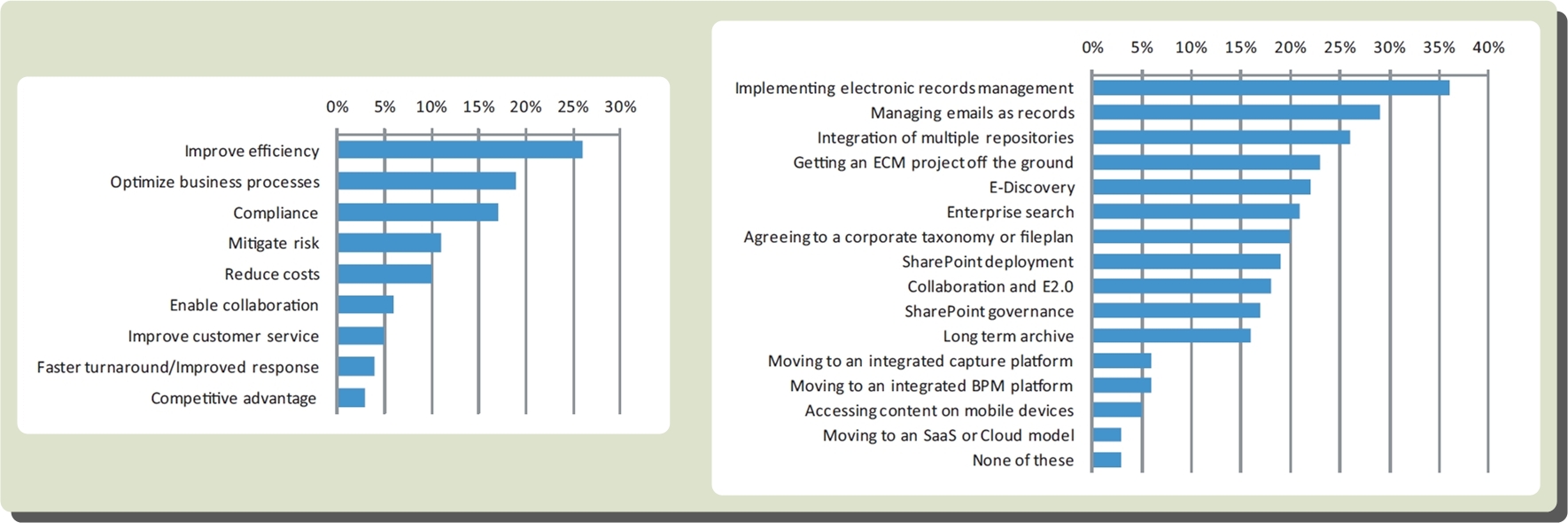
What’s striking to me is the disconnect between what folks say the key cost drivers are (improved efficiency and optimized business processes) and what they say their ECM priorities are (implementing electronic RM and managing emails as records). Because what you’ll get from delivering RM for electronic content and emails is not primarily efficiency gains and better business processes across the enterprise. So what’s up?
I think a number of things could be behind this.
- First, since we don’t have many executive respondents here, it’s possible that more business-focused concerns are under-represented.
- Second, since many organizations don’t have executive level support of ECM, it’s possible that no one has ever taken the ECM owners to task over the discrepancy between what they say the benefits of their systems are and what actually gets delivered.
- Third, it may be that there isn’t a tight linkage between ECM product SKUs and business drivers. Vendors have tended to sell modules around things like RM or email management rather than business drivers like competitive advantage–although that’s shifting somewhat with things like advanced case management, customer communication management, and collaboration.
- Finally, it could also be due in part to the mechanics of the survey itself, which asks about big bucket categories like “improve efficiency” alongside more granular ones like “improve customer service” and blurs the lines between categories of drivers.
The final word
In the end, this is a great survey, really eye-opening, excellent data points for anyone involved in ECM. Would love to hear what folks think of the report or my take on it: does it gel with your experiences over the last year, what you’re seeing in the industry or your organization? If not, what’s been different for you? For your organization?
Jump in and let’s get the conversation started…
Keep your document collaboration compliant
I posted an article last week at CMSWire on 3 Ways Document Collaboration is Becoming More Social. I don’t want to rehash the details here, but rather build on what I said there to consider some of the compliance implications of managing documents more collaboratively, which can be serious, particularly for organizations in regulated, compliance-driven industries like financial services, insurance, banking, or pharma.
In the article, I talked about three ways I think document management will get more collaborative in the next 18 – 24 months:
- Some documents will no longer be documents at all – we’ll stop using documents to do those things that are better accomplished with social collaboration tools, whether because the information in these documents has a short useful lifespan or because it would benefit from the fluidity that social collaboration tools provide.
- Some documents will no longer begin their lives as documents – we’ll create some documents as other kinds of content (e.g., wikis, conversation threads, blogs) and then migrate them to documents at a certain point in their lifecycle (e.g., major draft versions, final published version).
- Some documents will remain documents throughout their lifecycle, but how they get created and shared will change – even when we’re doing good old-fashioned document management from cradle to grave on a document, we’ll begin creating and sharing that document in new ways.
What I want to discuss here are some of the compliance implications of these shifts, because while there’s a tremendous amount of excitement about social media and collaboration tools for the enterprise, there’s not a whole lot of talk about how to remain compliant while using them.


 agile ramblings