The money and the power
Those of you who are regulars here know that I’ve been digging into James Gleick recently. I published a review of What Just Happened on my other blog, and my last post here took Gleick as a jumping off point for waxing historical; this post does the opposite: I want to take a particularly sharp insight he made about Microsoft in 1998 and use it to think about where we’re headed as we approach the midpoint of 2011.
Microsoft is a forward-looking company with a sharp eye for the power points, the lever arms, the control valves in the emerging digital economy. In the software sector of the economy of the late eighties and early nineties, there was just one important power point: the operating system. Microsoft owned it and used it to gain dominance over that entire sector. In the helter-skelter Internet-driven world we’re now entering, a variety of power points are taking form. The start-up screen, what you see when you turn on your computer, is a power point; Microsoft insists that manufacturers hand over all rights to that screen. We’re not just plumbing.
Internet search sites are power points, because they can become habitual portals of entry for users seeking information or ways to spend their money. That’s why it was important to make sure that your Search button would take you to a page at home.microsoft.com.
James Gleick, What Just Happened, (p. 210)
You are correct, Sir
 Despite the fact that the essays in What Just Happened are ancient by Internet standards, Gleick doesn’t get much wrong in them, and his assessment of Microsoft is no exception. As a company, to this day, they continue to try to leverage what he calls power points. And while they’ve failed in some cases (music, search, mobile), they knocked it out of the park in others (desktop software, document management, development platform).
And I think the most important thing for me about what Gleick’s saying here has less to do with Microsoft (or any other specific company) and more to do with the general principle of leveraging power points. In the thirteen years since he wrote this article, the companies that have been able to find and leverage power points have achieved massive success.
iPod, iTunes, Microsoft Office, SharePoint, .NET, Google, Android—all these products are great examples of what it means to leverage power points…and have made their creators (and their business partners) huge amounts of cash. And along the way they’ve given us consumers some killer products that have changed the way we work and live.
But all this stating of the obvious begs an interesting question or two:
- What are the power points currently up for grabs?
- How are things looking for the main contenders (and maybe the dark horses most folks are unaware of)?
The final word
Over the course of the next few posts, I want to take a look at some of the areas where I see power points up for grabs today.
- Social Business Software—this is an emerging domain that has a whole new cast of players jockeying alongside industry giants to gain control.
- Document Management—this one has been settled since shortly after MOSS 2007 was released and has seemed in the bag for Microsoft through the release of SharePoint 2010…but there are rumblings on the horizon that make Microsoft’s domination less-than-certain going forward.
- End-user computing hardware—aka, tablets, this one has the potential to restart competition over previously settled power points like browser, desktop software, and development platforms.
- The application layer—aka, SaaS, The Cloud, the app store model, etc., this one is less about outsourcing than about the balance of power in how businesses procure software.
In the meantime, I’d love to hear from folks out there about Gleick’s ideas, my take on them, or your take on them. While I let the next post percolate, jump in, and let’s get the conversation started!
I’ve been reading a lot of James Gleick recently. For those of you unfamiliar with Gleick, he’s a fantastic science and technology writer, best known for his biographies of key figures in the history of science and mathematics (Feynman, Newton).
I recently finished What Just Happened, a collection of his technology essays written from 1991 – 2001. He covers a wide range of subjects, from WinWord user groups to the future of money in the digital age and the quality of early-90s internet porn. It’s not only a real page-turner, but an amazing time capsule from the earliest days of the Internet.
I’m going to review the book later this week, so I won’t say more in that vein here. But I came across a passage that really got me thinking about the role information plays in human culture, both for how we understand ourselves and contemporary society as well as our historical ancestors and their culture. It’s long, but worth reading in full to set the stage for this post (which is even longer).
Who, if anyone, will decide what parts of our culture are worth preserving for the hypothetical archaeologists of the future? Can any identification scheme help readers distinguish true copies from false copies in the online world’s hall of mirrors? What arrays of optical or magnetic disks might provide reliability and redundancy for more than a few years of storage? Still, hope comes from the simple truth that the essence of information does not lie in any technology, new or old. It’s just bits, after all.
In the world before cyberspace, countless bridge hands were played and words spoken and memory vanished like vapor into the air. Think of all that data, dissolving no sooner than it was formed. Once in a while people managed to snatch a bit back from the ether, with pen or paper or, later, audio- and videotape. They succeeded in saving for posterity a fair portion of what was worth saving: the speeches of Lincoln (the major ones), the poetry of Shakespeare (but not quite reliably), the plays of Sophocles (except the lost ones), and a few dozen terabytes more.
James Gleick, What Just Happened (pp. 200-201)
Although Gleick’s writing about our penchant to keep everything digital, he’s skirting around the edges of some concepts that are fundamental to how we think about history. I want to unpack the most interesting of these here in some detail, because I think they not only help us view Gleick’s ideas in a larger context, they help us see these historiographical concepts in a new light as well.
Read more…
Transformational ECM V: For-Profit Education (Part 2)
Last post I started to take a look at how enterprise content management (ECM) is transforming for-profit education providers. I began with an overview of the for-profit ed space, because although most folks have heard of it, it’s not as well-known a vertical as CPG, financial services, insurance, etc.
With that done, I want to turn to look at some of the particular ECM needs of for-profit ed providers and how fostering better content management practices can help transform these organizations.
Transformational ECM V: For-Profit Education (Part 1)
Before my recent foray into the world of Advanced/Adaptive Case Management, I was in the middle of a series on organizational transformation that focused on how enterprise content management (ECM) should be seen less in terms of technology, process, compliance, or risk management, and instead as a powerful force for transformational change at organizations.
In those posts, I took a close look at how ECM is transforming a range of industries: health payers, mining companies, consumer packaged goods (CPG) organizations, property and casualty/life insurers, and financial services organizations.
Now that I’ve emerged from the other side of the ACM looking-glass, in this post, I’ll return to considering how ECM can transform industries.
To that end, I want to turn to an industry that’s been growing like gangbusters in the last few years: for-profit education. Led by firms like Apollo and Kaplan, it’s been transforming the face of higher education in the U.S. and across the globe. But with that growth come some substantial challenges, and as we’ll see, ECM can help these firms meet them.
But before we get to ECM, let’s take a closer look at the for-profit ed market.
ACM: Where’s Jack Handey when you need him?
As much as I’m interested in advanced/adaptive case management (ACM), this has been a long series (or at least it’s felt long!), and so I want to wrap up this week and turn to other topics.
But before I do, I figured I owe it to you all out there to try to step back from definitions, question-posing, and the review of existing literature to say something positive/constructive about the state of ACM.
So, with that goal in mind, let me share some opinions and thoughts on ACM today.
Review of Mastering the Unpredictable
I want to continue my series of posts on advanced (or adaptive) case management (ACM) with a book review. On the advice of a colleague, Mike Nishiki, a few weeks ago I picked up Mastering the Unpredictable, a collection of ACM essays edited by Keith D. Swenson, VP of R&D for Fujitsu.
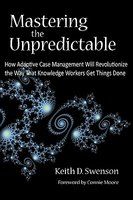
I’ll begin by saying that as far as I know this is the only book on ACM out there–so there’s nothing to compare it to. Given the relatively recent emergence of ACM as a domain, this isn’t surprising. But it does present two challenges for a reviewer…
BPM + ACM = ACABPM?
For those of you keeping score, I’m in the middle of a series of posts on advanced (or adaptive) case management (ACM). And in all of them, I’ve kind of assumed that there’s a domain called ACM that is distinct from other domains out there, particularly business process management (BPM).
But somewhere deep down in my heart of hearts, I find myself thinking that maybe we don’t need a new term for what ACM describes, that maybe, just maybe, we could expand how we view other domains to more explicitly encompass what ACM does, i.e., dynamic, less predictable, knowledge worker activities.
A rose by any other name…
I’m in the middle of a series of posts on ACM—advanced (or adaptive) case management. My goal is to spend some time explaining my understanding of ACM in more detail, both what it is and what it can be used for.
Last post I kind of owned up to having come a long way in my understanding of and appreciation for ACM:
Basically, I’ve moved from thinking it was a domain invented by ECM vendors to reignite interest in their products, to thinking it was a domain invented by BPM vendors to reignite interest in their products, to admitting that it might just be a legitimate domain in its own right. And in my travels, when ACM comes up, I’d say nine out of ten people I talk to fall somewhere on my continuing journey to ACM acceptance.
So this post, I want to dig in and provide my best shot at explaining what ACM is (and isn’t), which will hopefully be of use to those of you out there still working to wrap your heads around the domain.
ACM ECM BPM WT(bleep)?
I’ll own up and admit that my attitude toward Advanced Case Management (ACM) is, shall we say, emerging. It wasn’t helped any by the fact that, depending on who you asked, ACM could stand for Advanced or Adaptive Case Management. The former returned 14.7M hits on Google, the latter 6.83M, for what that’s worth…
Basically, I’ve moved from thinking it was a domain invented by ECM vendors to reignite interest in their products, to thinking it was a domain invented by BPM vendors to reignite interest in their products, to admitting that it’s a legitimate domain in its own right.
And in my travels, when ACM comes up, I’d say nine out of ten people I talk to fall somewhere on my continuing journey to ACM acceptance. So I figured it would be a good topic to dig into a bit here and begin shedding some of my own light (dim though it may be) on the subject.
I’m in the middle of a series on organizational transformation that focuses on how enterprise content management (ECM) should be seen less in terms of technology, process, compliance, or risk management, and instead as a powerful force for transformational change at organizations.
In recent posts, I’ve taken a close look at how ECM is transforming health payers, mining companies, and consumer packaged goods (CPG) organizations. In this post, I want to continue my industry focus with a set of verticals that have traditionally been the mainstay of ECM: property and casualty/life insurance and financial services (FS).


 agile ramblings